
Introduction
Crafting an effective email transcends merely typing words on a screen; it’s about forging a meaningful connection with the recipient. By adhering to proven practices in email communication, individuals can significantly elevate their capacity to convey messages with clarity and impact. But amidst the countless email exchanges, how can one ensure their message resonates and elicits the desired response? This article explores four essential strategies for effectively relating messages in emails:
- Defining purpose
- Tailoring content to the audience
- Ensuring clarity
- Incorporating compelling calls to action
Define the Purpose of Your Email
Before you compose your message, take a moment to outline its intent clearly. Ask yourself: What do I want to accomplish with this message? Whether your goal is to inform, request, or persuade, having a will guide your writing and keep you focused. For instance, if you're reaching out to a potential client, your aim might be to arrange a meeting or provide details about your services. Clearly stating this purpose at the beginning of your correspondence helps to relate the message, setting the tone and context for the rest of your communication, making it easier for the recipient to grasp your intent and respond appropriately.
achieve 20% higher than those with multiple objectives, underscoring the . Furthermore, , and including (CTAs) can further enhance engagement. Messages with tailored CTAs experience considerably higher conversion rates compared to generic options. A successful example is PureGym, which achieved a 55% message open rate by providing timely updates with a . This illustrates how effective communication can and encourage positive responses.

Tailor Your Message to the Audience
To effectively, is crucial. Have you considered who will be reading your message? By to fit your audience, you can significantly and enhance your communication's impact.
For instance, when emailing a senior executive, adopting a formal tone and focusing on high-level insights is advisable. Conversely, if your audience consists of peers, a more casual and friendly approach may be more effective.
By , you can in a way that shows you value the recipient's unique perspective and needs. This attention to detail can and .

Ensure Clarity and Conciseness
To craft an effective email, prioritize . Start with a succinct introduction that clearly states your purpose, followed by the key points you wish to convey. Utilize or numbered lists to simplify complex information, making it more digestible for the reader. Avoid jargon and overly complex sentences; instead, use straightforward language that communicates your message efficiently. For instance, rather than saying, 'I would like to take this opportunity to discuss the potential for collaboration,' simply state, 'Let's discuss .' This method not only respects the recipient's time but also enhances the likelihood of a positive response.
Furthermore, strive to to demonstrate professionalism. Ensure your and indicative of the message's content, as this aids in organization and retrieval. Remember to to maintain professionalism and clarity. Lastly, be mindful of and Reply All functions, which can clutter inboxes and lead to confusion.

Incorporate a Strong Call to Action
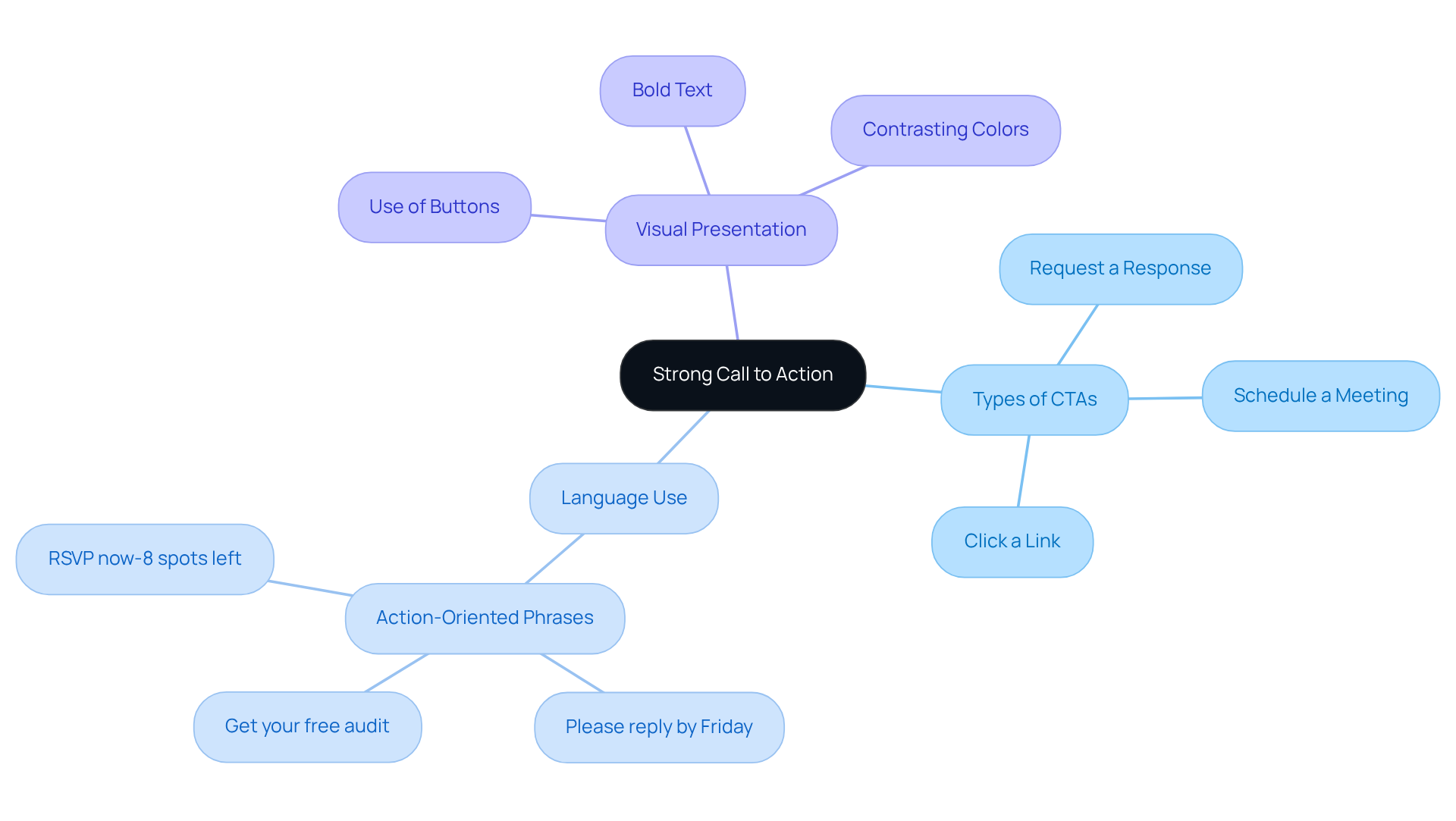
Every email must feature a . This could be a request for the recipient to respond, schedule a meeting, or click a link for further information. Use that inspires the audience to take the next step. For example, instead of saying, 'I hope to hear from you soon,' consider saying, 'Please reply by Friday to confirm your attendance.' Furthermore, make your CTA by employing buttons or bold text, ensuring it stands out in the email. A can significantly help to and of the recipient taking the desired action.
Conclusion
Crafting effective emails is essential for clear and purposeful communication. By defining the intent behind your message and tailoring your approach to your audience, you significantly increase the likelihood of achieving desired outcomes. Each of these practices is vital for enhancing the overall effectiveness of email communication.
A well-defined purpose not only sets the tone for your message but also boosts engagement. When you tailor content to suit the recipient's preferences and needs, you foster stronger connections. Clarity and conciseness show respect for the recipient's time and attention. Moreover, a compelling call to action drives the reader toward the next steps, making it easier for them to respond favorably.
In an era where digital communication reigns supreme, mastering these best practices can turn email interactions into opportunities for meaningful engagement. By implementing these strategies, individuals and organizations can enhance their email effectiveness, leading to more productive conversations and successful outcomes. Prioritizing clarity, audience awareness, and actionable steps will ensure that your messages resonate and achieve their intended goals.
Frequently Asked Questions
Why is it important to define the purpose of an email before composing it?
Defining the purpose of an email helps clarify the intent behind the message, guiding the writing process and keeping the focus on the desired outcome, whether it's to inform, request, or persuade.
How can clearly stating the purpose at the beginning of an email benefit communication?
Clearly stating the purpose at the beginning helps set the tone and context for the message, making it easier for the recipient to understand the intent and respond appropriately.
What impact does having a distinct, singular message in an email have on engagement?
Emails with a distinct, singular message achieve 20% higher click-through rates than those with multiple objectives, highlighting the importance of clarity in communication.
How do customized messages compare to standard ones in terms of effectiveness?
Customized messages significantly outperform standard ones, leading to higher engagement and better responses from recipients.
What role do calls to action (CTAs) play in email effectiveness?
Including impactful CTAs can enhance engagement, with messages that feature tailored CTAs experiencing considerably higher conversion rates compared to generic options.
Can you provide an example of effective email communication?
An example is PureGym, which achieved a 55% message open rate by providing timely updates with a clear purpose, demonstrating how effective communication can boost engagement and encourage positive responses.
List of Sources
- Define the Purpose of Your Email
- Blog: 14 Best Practices for Effective Email Marketing (https://www1.appliedsystems.com/en-us/blog/posts/best-practices-for-effective-email-marketing)
- The Importance of Clarity in Emails (https://linkedin.com/top-content/communication/importance-of-clarity/the-importance-of-clarity-in-emails)
- optimove.com (https://optimove.com/resources/blog/email-marketing-tips-and-strategies)
- braze.com (https://braze.com/resources/articles/email-campaign-best-practices)
- Email Marketing Statistics | Ultimate List | CodeCrew (https://codecrew.us/blog/email-marketing-stats-you-need-to-know-the-ultimate-list)
- Tailor Your Message to the Audience
- azira.com (https://azira.com/blogs/what-is-audience-analysis-and-why-is-it-essential-for-marketers)
- forbes.com (https://forbes.com/councils/forbescommunicationscouncil/2024/02/27/nine-effective-elements-to-include-in-your-next-email-marketing-campaign)
- Audience Analysis Drives Marketing Strategy - FINN Partners (https://finnpartners.com/uk/news-insights/the-power-of-audience-analysis)
- linkedin.com (https://linkedin.com/top-content/customer-experience/engaging-customers-through-personalization/best-practices-for-tailoring-marketing-messages)
- Understanding Your Target Audience: The Key to Effective Marketing (https://workforceinstitute.io/digital-marketing/how-to-understand-target-audience)
- Ensure Clarity and Conciseness
- Email Etiquette in the Workplace (https://adminvc.ucla.edu/news/email-etiquette-workplace)
- socialtrendspot.medium.com (https://socialtrendspot.medium.com/email-etiquette-5-strategies-for-clear-concise-communication-c21ef0a413eb)
- globallearningpartners.com (https://globallearningpartners.com/blog/10-tips-for-effective-e-mail-communication)
- n-o-v-a.com (https://n-o-v-a.com/blog/email-etiquette-8-steps-to-clear-and-concise-communication)
- higheredjobs.com (https://higheredjobs.com/Articles/articleDisplay.cfm?ID=3841&Title=How%20to%20Write%20Better%20Emails%3A%20Communicating%20with%20Clarity%20and%20Kindness)
- Incorporate a Strong Call to Action
- Blog: 14 Best Practices for Effective Email Marketing (https://www1.appliedsystems.com/en-us/blog/posts/best-practices-for-effective-email-marketing)
- 10 Tips to Optimize Your Email CTAs (https://campaignmonitor.com/resources/guides/10-tips-to-optimize-your-calls-to-action-in-email-2)
- A Strategic Guide to Calls-to-Action (CTAs) in Email Marketing: Best Practices for Success (https://litmus.com/blog/click-tap-and-touch-a-guide-to-cta-best-practices)
- 20 Expert Tips For Crafting Better CTAs To Drive Action Through Email (https://forbes.com/councils/forbescommunicationscouncil/2025/07/03/20-expert-tips-for-crafting-better-ctas-to-drive-action-through-email)
- Call to Action in Emails: Examples, Templates, Tips [2026] (https://mailtrap.io/blog/call-to-action-in-emails)