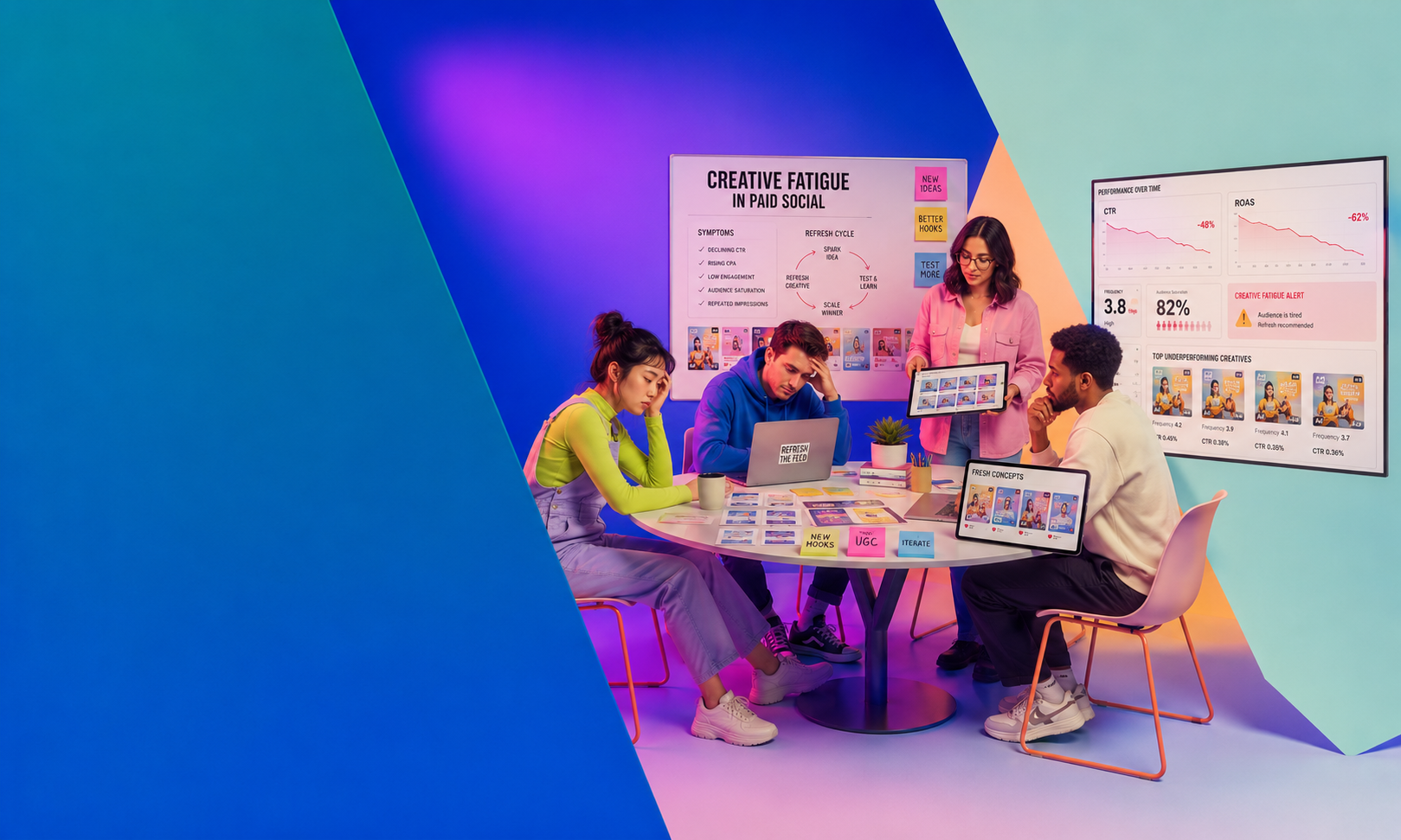
Creative fatigue is the drop in ad performance that happens when your audience sees the same creative too many times. Brands reduce it by spotting the warning signs early (rising frequency, falling CTR, rising CPA), running a steady pipeline of genuinely different creative, and refreshing the parts of an ad that wear out first, starting with the hook.
This guide covers how to identify creative fatigue, how to prevent it on Meta and TikTok, and how many new creatives to test.
What is creative fatigue?
Creative fatigue (also called ad fatigue) happens when an ad has been shown to the same people often enough that they stop paying attention. Engagement falls, click-through rate drops, and the platform has to spend more to get each conversion. It's different from audience saturation (you've reached most of the people available) and from offer fatigue (the offer itself stopped being compelling), although they often happen together.
Signs of creative fatigue
Compare each ad against its own baseline. Fatigue usually shows up as a combination of these signals:
- Frequency rising while reach growth slows.
- Click-through rate declining week over week.
- Hook rate or thumb-stop rate falling: fewer people watch past the first seconds.
- CPM, CPC, and CPA rising without changes to targeting or budget.
- Conversion rate slipping on the same landing page.
Before blaming the creative, rule out tracking problems, landing page changes, seasonality, and budget shifts. Here's a step-by-step guide to measuring creative fatigue.
How to reduce creative fatigue in paid social
1. Refresh the hook first
The opening seconds wear out fastest. New hooks on a proven body (a different first line, opening shot, or on-screen text) can extend a winning ad without a full reshoot. See paid social advertising best practices.
2. Build creative "families," not one-off ads
Keep a strong concept and vary the execution: different creators, angles (price, quality, convenience), formats (testimonial, demo, unboxing, skit), lengths, and CTAs. That gives the algorithm real variety without needing a new big idea every week.
3. Diversify creators and formats
Creator-led UGC is one of the most efficient ways to fight fatigue. The same brief, interpreted by different creators, produces genuinely different ads, not cosmetic variations.
4. Run a continuous creative pipeline
Treat creative as an always-on process: research → produce → test → learn → iterate. Keep a backlog of ready-to-launch variations so you're testing the next round before the current winners fade.
5. Test systematically
Change one major variable at a time and keep a proven ad as the control. A structured Meta ad creative strategy makes it clear what caused a lift.
6. Manage exposure
Overly narrow audiences burn through creative quickly. Broader targeting, consolidated ad sets, and frequency controls (where available) slow fatigue down.
7. Rotate gradually
Add a few new ads at a time rather than replacing all winners at once, so the platform can compare new creative against proven performers.
Turn performance signals into your next creative brief
Explore how MediaNug approaches creator-led production and performance creative for paid-social teams.
Explore MediaNug Performance Creative
How many new ad creatives should you test each month?
There's no single number. The right volume depends on how much you spend and how fast your ads fatigue. Use these principles:
- Scale creative volume with spend. The more budget you run through an audience, the faster ads wear out and the more new creative you need.
- Give each test enough budget to learn. Launching more ads than your budget can support spreads spend too thin to find winners.
- Refresh on signals, not on a calendar. Replace or iterate ads when fatigue indicators appear. Don't swap winners just because a week has passed.
- Balance iteration and exploration. A common approach is to put most new creative into variations of proven concepts and a smaller share into genuinely new ideas.
- Follow platform guidance. TikTok, for example, recommends running several distinct creatives per ad group rather than a single ad.
For brands spending heavily on Meta and TikTok, that usually means a weekly flow of new variations, which is exactly what an always-on UGC program is designed to deliver.
Creative fatigue on Meta vs. TikTok
- TikTok: content cycles fastest. Trends, sounds, and formats age quickly, so native, creator-led content and frequent hook refreshes matter most.
- Meta (Facebook and Instagram): ads can run longer, especially with broad targeting, but frequency still climbs in retargeting and small audiences. Mix formats (Reels, Stories, static) to extend creative life.
Building an always-on creative engine
Most brands don't struggle to understand creative fatigue. They struggle to produce enough good creative to stay ahead of it. MediaNug runs always-on creative testing and UGC production for brands on Meta and TikTok. Teams that want to produce creator content themselves can use NugVerse, MediaNug's self-service UGC platform.
Frequently asked questions
How do you know if an ad has creative fatigue?
Look for rising frequency together with falling CTR and rising CPA, compared with the ad's own earlier performance. Rule out tracking, landing page, and budget changes first.
How often should you refresh ad creative?
Refresh when performance signals show fatigue rather than on a fixed schedule. High-spend accounts on TikTok and Meta often need new variations weekly.
What is the difference between creative fatigue and audience saturation?
Creative fatigue means people are tired of a specific ad. Audience saturation means you've reached most of the available audience. New creative fixes the first. Broader targeting or new audiences fix the second.
Does UGC help with creative fatigue?
Yes. UGC makes it practical to produce many distinct ads from different creators and angles, which keeps creative fresh at a sustainable cost.